
Do your best work,
with fewer interruptions.
Your best hours get eaten by “got a sec?” Currant catches every ask and sets your status, so your best hours go to your best work.
Free, and it sets itself.

Async work waits invisibly.
Teams rarely stall because no one's working. They stall because work waits — unanswered mentions, stale decisions, reviews nobody picked up. Meanwhile the day fills with interruptions, and the queue lives in your head.
You already have a system for this. It's costing you.
Everyone has their workarounds for a noisy day. Four familiar ones — and what happens when the queue does the work instead.
Leave it on read — or notifications off entirely — and hope nothing was urgent. The guilt compounds, and the asker re-pings anyway.
A fake meeting to defend your morning. Fools no one, and the asks just pile up out of sight.
The day goes to “got a sec?” — so the real work starts after dinner.
The week's unanswered pile, cleared on your own time. Every week.
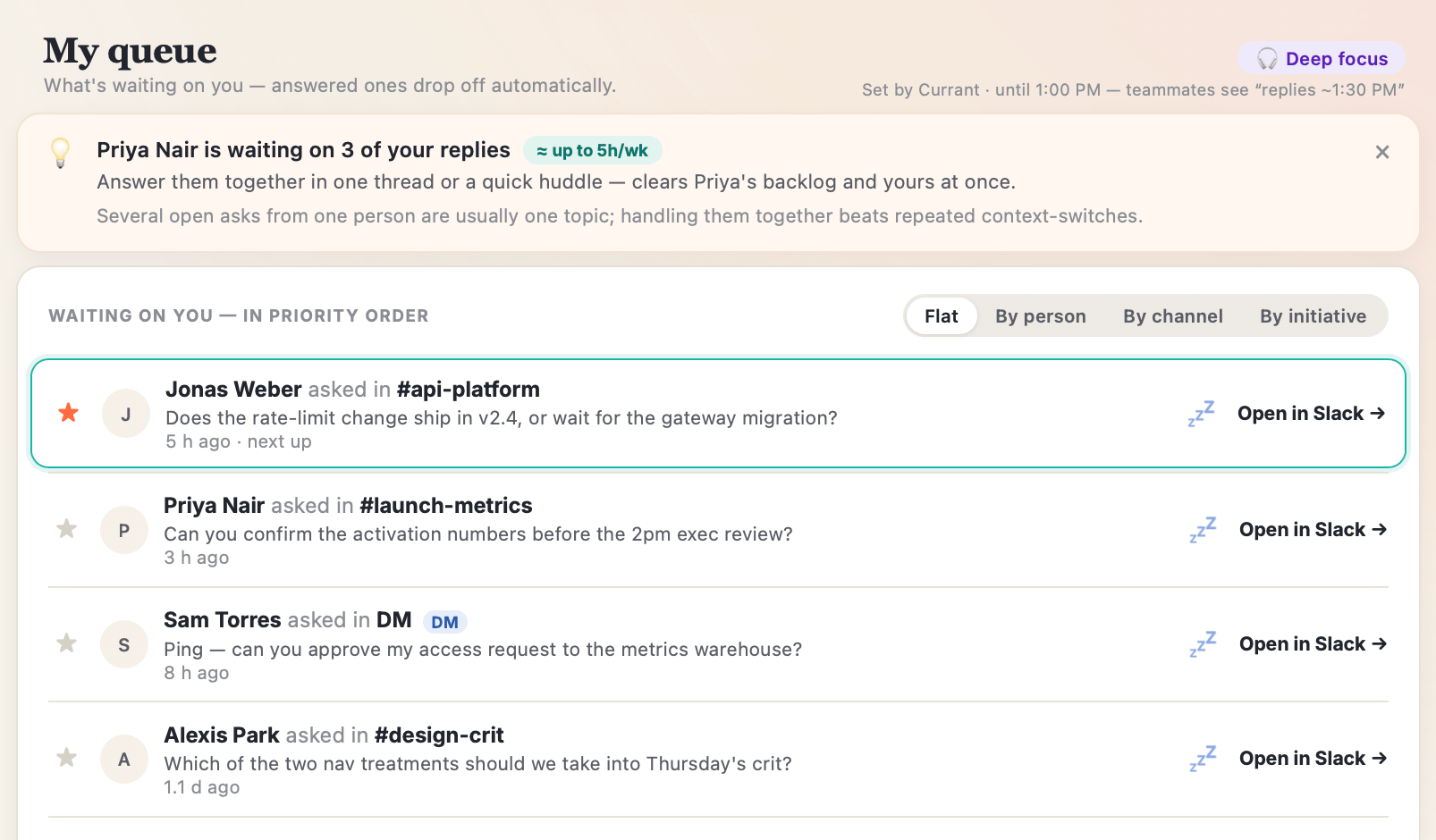
Everything waiting on you, in one place.
Every unanswered @mention — and the asks that never mentioned you — gathered into one queue, in priority order. Open it when you're ready, clear it in one pass, and get back to real work.
- Nothing slips. Mentions, DMs you've allowed, even implicit asks — if it's genuinely waiting on you, it's here. A ✅ or a quick "thanks" clears it on its own.
- Priority, not pile. The queue orders itself — who's blocked, how long, what unlocks the most — and marks what's next up.
- One-line summaries. See what each thread actually needs before you click — computed on demand.
- Your pace. Snooze what can wait, pin what can't, and watch the cleared count grow.

A softer Slack status that sets itself.
If you turn it on, Currant sets your status from that same queue — so teammates see what to expect without you typing a word, and stop guessing whether you saw their message.
 currantAPP9:41 AM
Your status, your call.
Currant is the opposite of a tracker. It runs on metadata — that a mention happened, whether it's been answered — and keeps nothing of what you write. No content, no profile, no behavior score to mine later.

- Metadata, not messages. It stores who's waiting on whom — never message text, never your DMs.
- Each feature is a switch. Status, summaries, your inbox — separate opt-ins, each asking only for the access it needs.
- You stay in control. Override, snooze, or pause any time — only you can set your status.
- Leaving is clean. Opt out and it stops; uninstall and the workspace's data is erased.
 currantAPPOnly visible to you
- the decision you actually need
- the context & links to make it
- when it has to land
When someone's stacked up, help the work land.
When you're about to message a teammate who's Stacked up, Currant quietly shows you a private heads-up — only you see it — so your ask lands complete the first time, and you get a real answer in one pass instead of a day of back-and-forth.
Send less, but send it whole — and act the moment they reply. Their attention stays protected, and your work moves faster.
Same thing.
What's limiting how much your team can ship?
Not effort. An organization is a system — output is set by how work routes, how many things run at once, and who can decide. Currant brings that system into view; every fix it suggests changes the system, not the pressure on a person.
- See the system: where work waits, piles up, or circles — and where attention is split too thin.
- Size the fix. The waiting in hours and dollars — the case for a backup, a smaller portfolio, or more hands.
- Fix the system. A cross-trained backup, fewer parallel initiatives, an owner for the stuck decision. People get focus back; the team ships more.
Useful before lunch. Boring to set up.
No workflows to design, no fields to fill. Install it, and the queue simply starts catching what's waiting. Everything else is your call, one switch at a time.
Install
An admin adds it to Slack. Currant starts noticing asks and answers — content-free — and everyone's queue builds itself.
Open your queue
Already filling, in priority order — next up marked, one person's asks gathered into one pass. A reply anywhere clears it.
Feel it by Friday
The queue pays off day one — and that first Friday, one pass through it replaces Sunday's catch-up. Quieter mornings and fewer re-pings build from there, as teammates get to trust the status.
Clear queue. Clear head.
Do your best work, with fewer interruptions — starting the day you install it.
No pressure. Just more clarity.